Saving precious remains
There are few signs today of the Philippines' once sprawling rainforests. With a growing trend in human population, it is hoped that the country's marine environment will not suffer the same fate.
Overfishing and destructive fishing
Fishers in the Philippines are increasingly coming home with pitiful catches. Of a number of factors which have led to this situation, one stands out: over-fishing in many areas. According to the Asian Development Bank (ADB), there has been a drop of 90% in the quantity of marine organisms that can be trawled in some traditional fishing areas of the Philippines.
This isn’t just a question of declining fish stocks and biodiversity, but also of social impacts and economic losses. Mismanagement of fisheries resources is estimated to cost US$ 420 million annually in lost revenues.
At the root of the overfishing problem is weak fisheries management, ineffective policies and poor enforcement of fishery laws.
Fishers in the Philippines are increasingly coming home with pitiful catches. Of a number of factors which have led to this situation, one stands out: over-fishing in many areas. According to the Asian Development Bank (ADB), there has been a drop of 90% in the quantity of marine organisms that can be trawled in some traditional fishing areas of the Philippines.
This isn’t just a question of declining fish stocks and biodiversity, but also of social impacts and economic losses. Mismanagement of fisheries resources is estimated to cost US$ 420 million annually in lost revenues.
At the root of the overfishing problem is weak fisheries management, ineffective policies and poor enforcement of fishery laws.
Coastal infrastructure development
Coastal zone development has been particularly damaging to the Philippines’ marine environment, especially to coral reefs, mangroves, and seagrasses.
As populations have increased, so have their needs for construction materials and living space. Excavation, dredging, and coastal conversion to accommodate coastal development have seen corals being extracted for reclamation and construction, especially in coastal villages.
Mangroves have particularly suffered from coastal development, notably at the hands of the aquaculture industry. In the Philippines, aquaculture has reduced mangrove stands to only 36% of 1900 levels.
Coastal zone development has been particularly damaging to the Philippines’ marine environment, especially to coral reefs, mangroves, and seagrasses.
As populations have increased, so have their needs for construction materials and living space. Excavation, dredging, and coastal conversion to accommodate coastal development have seen corals being extracted for reclamation and construction, especially in coastal villages.
Mangroves have particularly suffered from coastal development, notably at the hands of the aquaculture industry. In the Philippines, aquaculture has reduced mangrove stands to only 36% of 1900 levels.
Deforestation
After decades of deforestation, which has left about 3% of the original cover, forests continue to be under threat from agriculture and urbanization, illegal logging and forest fires.
Sustained forest loss in the Philippines is causing severe soil erosion, and is threatening the country’s rich biodiversity. This is particularly worrying as many of the Philippines’ species, which depend on these forests, are endemic (they cannot be found anywhere else in the world). For example, of 180 native terrestrial mammal species here, about 61% are endemic.
Inconsistent laws, inadequate regulations, weak enforcement and lack of funding are making forest conservation a major challenge.
After decades of deforestation, which has left about 3% of the original cover, forests continue to be under threat from agriculture and urbanization, illegal logging and forest fires.
Sustained forest loss in the Philippines is causing severe soil erosion, and is threatening the country’s rich biodiversity. This is particularly worrying as many of the Philippines’ species, which depend on these forests, are endemic (they cannot be found anywhere else in the world). For example, of 180 native terrestrial mammal species here, about 61% are endemic.
Inconsistent laws, inadequate regulations, weak enforcement and lack of funding are making forest conservation a major challenge.
Pollution
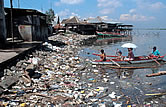
Only about 10% of sewage in the Philippines is treated or disposed of in an environmentally sound manner. The rest goes back to nature – usually the sea.
In this context of poor waste treatment and high population growth, water pollution is a growing problem for the country’s groundwater, rivers, lakes, and coastal areas. Polluting industrial material is also found in abandoned mining areas, with mercury pollution affecting water bodies in these areas.
These problems are unfolding in a context of poor planning, and weak management and enforcement of regulations.
Only about 10% of sewage in the Philippines is treated or disposed of in an environmentally sound manner. The rest goes back to nature – usually the sea.
In this context of poor waste treatment and high population growth, water pollution is a growing problem for the country’s groundwater, rivers, lakes, and coastal areas. Polluting industrial material is also found in abandoned mining areas, with mercury pollution affecting water bodies in these areas.
These problems are unfolding in a context of poor planning, and weak management and enforcement of regulations.
My Personal Insights
Now this article came from the WWF (World Wildlife Fund) which talked about the environmental problems in the Philippines. Now what I've learned based on what I read is that if these problems would continue, Philippines very vast biodiversity wouldn't be that diverse anymore due to the fact that these problems really affect a lot of animals who are living here in the Philippines. You can see that our government should take much more responsibility in taking care of our forest, seas, and animals because they are one of the factors that makes our country beautiful and A LOT of the animals here in the Philippines cannot be seen in other places and we should be proud of that and take care of those animals.
I would suggest our government should implement strict laws to ensure the safety and preservation of our natural resources and to make sure the children of the future would still be able to see the magnificent creatures that live ONLY in the Philippines.
In my own little ways I could help the people who are trying really hard to preserve out natural resources by doing the REDUCE, REUSE, RECYCLE method so that I wouldn't waste anything or at least reduce the amount of waste I bring to the environment. I could also tell my friends, family, and relatives about what I've learned so that they too would follow what I've been doing and make our environment cleaner and greener.
SOURCES:

No comments:
Post a Comment